By Will Dart
How to catch a swarm of honey bees
My bee-wrangling journey began very simply, with a call to a bee supply company in a neighboring town. I was looking for a swarm to purchase; the woman I spoke with informed me that they were out of swarms (I called in June, too late in the season), but that she could put me on their "swarm list" if I wanted. (A "swarm list" is a list of people who volunteer to remove bee swarms that show up in people’s yards.) I had no experience with swarms whatsoever--I’ve never even seen one in person--but I had a friend who had told me about catching swarms and who I knew I could call for advice, and, well, I just couldn’t pass up being put on a "swarm list." Since this company was not that close to where I lived, the woman suggested I also contact a local pest control company, which, she said, usually keep swarm lists as well. (The people who find the swarms usually call either bee supply companies or pest control companies to take care of them, and these companies then pass on the name of the first person on their swarm list. It seems it is illegal to kill bee swarms, so the pest control people don’t want to deal with them--they’re more set up to kill cockroaches than to save bees--and happily pass on the responsibility to beekeepers looking for more bees). I made the call to the local pest control company and, sure enough, the guy kept a swarm list and, boy, it was too bad I didn’t call last week, because there had been a swarm right in my area. He was happy to put me on the list.
This was, I must admit, all sounding pretty dubious to me--just put yourself on a swarm list and go grab a pack of bees--and I couldn’t believe anything was really going to come of it. Didn’t I need some kind of qualification for this? And just how many swarms are out there anyway? Surely not very many. Like I said, I’ve never seen one, and no one I know (other than my beekeeper friend) has either. And even if a swarm was found in my area, how did I think I was actually going to catch it? Who was I kidding? I was lamenting my bad timing and my lack of bee-keeping experience, thinking I’d probably just end up ordering a swarm in the mail the following spring.
The next morning I got a call on my cell phone from my wife. "Will, there’s a swarm." "What?" I said. What was she talking about? Is there a riot somewhere? "Someone called about a swarm of bees in a tree in their yard!" I was speechless. One day! I hadn’t even gotten my box ready, or my bee-keeping suit. A grand rush of adrenaline blasted through my body, and the day suddenly looked very different. I sputtered something to my wife, called the people with the swarm, found out where they lived, and nervously went about my day, like an expecting father. I wouldn’t be able to get to them until later in the day, and I was worried they wouldn’t still be there when I arrived. But I remembered that my friend had told me it’s best to get swarms either in the morning or evening anyway, when they are less active, more docile, and more easily corralled. I willed them to stay put. (By the way, I got two more calls for swarms in my area within a week. There are swarms out there.)

Later that day I went home and got my high-tech bee-wrangling equipment ready. I found a medium-sized cardboard box in the basement, about the size of a liquor box, and cut a 4"x4" hole in one end, over which I firmly duct-taped a mesh screen. Then I got out my bee suit (a couple pairs of pants, a sweatshirt and a rain jacket, a pair of thick leather gloves, a pair of boots, some loose mosquito netting, a wide-brimmed hat and a roll of duct tape), strapped a ladder to the roof of the car with frayed bungee cords, and set off to find the swarm.
At the house a young boy told me the swarm was still there, in a tree around back. He asked me if I was going to trap it and take it away. Sure, I said. I smiled and tried to sound professional and confident. We both looked at each other; then he went back inside. I walked around the back of the house, and saw the swarm about eight or nine feet up a tree that was partly hanging over a fence, on the other side of which was a sidewalk and a road.
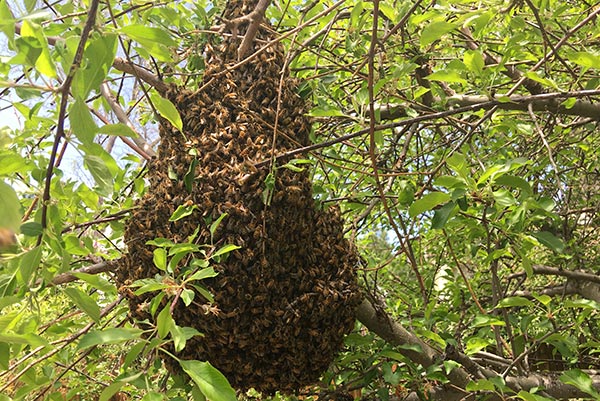
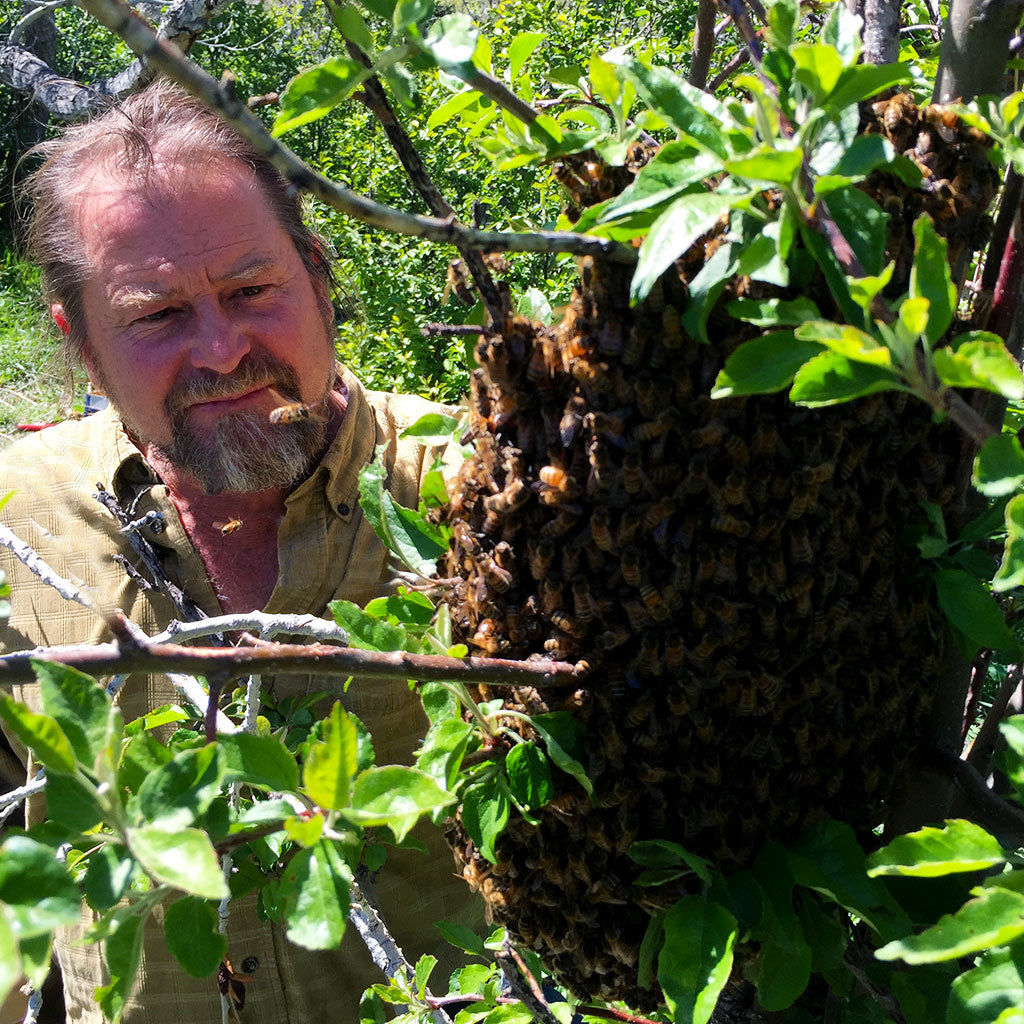
I went back to my car and drove around and parked on the road next to the tree, then got out and inspected the swarm more closely. It was about the size of a grapefruit, but slightly elongated, a mess of bees tightly packed together, with a hundred or more bees buzzing right around it. I put on my bee-keeping suit, duct-taped the my pants to my boots, tucked the mosquito netting firmly into my raincoat, set up the ladder next to the tree, and...stood there.
I could hear the buzzing of the bees, and my heart beating, and I couldn’t believe what I was about to do. What happened if they attacked me and my "suit" didn’t turn out to be bee-tight? Wouldn’t I look like an idiot, running down the street in my amateur bee suit, screaming and smacking myself in the face? I decided I couldn’t worry about that. I calmed myself down, and after a few minutes managed to get into a nice quiet bee-friendly state (I sent them gentle telepathic waves assuring them I was a harmless person, more or less insect-loving, who was only there to give them a good home). Then I climbed slowly up the ladder. The closer I got to the swarm the louder the buzzing was, but the bees did not seem to take any notice of me, even when I was only a couple feet away. The buzzing was beautiful, and hypnotic, and, in itself, calming. I went back down the ladder and got my box.
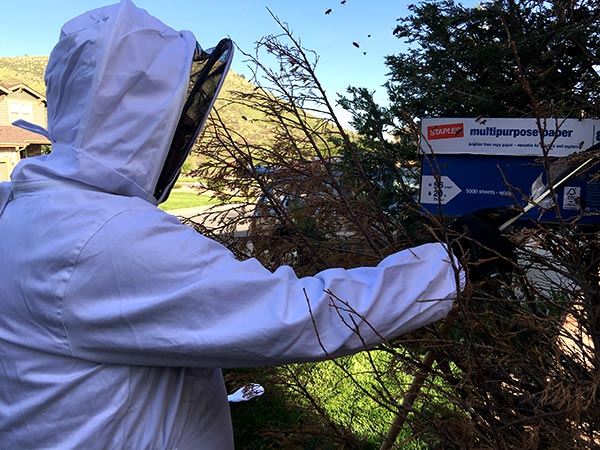
I climbed up till I was level with the swarm, and slowly extended the box until it was under the swarm, about a foot below it. Here was the moment of truth. I was still in my nice quiet bee-friendly state (which is a good state to be in), but I was also nervous as hell. I took hold of the end of the branch the swarm was attached to, took one last breath, and gave it one good, steady, firm (but not violent) shake.
Bees exploded everywhere. Some dropped into the box, but a whole cloud were suddenly in the air all around me, and the buzzing was now exponentially louder, like I was suddenly in the middle of a major psychic occurrence. I quickly, but calmly (quiet bee-friendly state), descended the ladder, set the box on the ground, and stepped back to watch. Despite the noise and activity of the bees, they did not seem to take any notice of me. They were just buzzing around the box and the tree. Part of the swarm was still attached to the branch, and there seemed to be a lot of confusion as to where the bees thought they should be. My friend told me that I would know by the behavior of the bees if the queen was in the box--the bees that were not with her would, after a moment of gathering themselves, begin to gravitate toward her, toward the box. As I watched it did not seem to me that the flying bees had much interest in the box, and the ones in the box did not seem to be grouping around any central point. As well, I had the feeling that my "pop" of the branch hadn’t been quite firm enough, and I didn’t think I’d gotten the queen. I needed to do it again.
I picked up the box, now almost high on the buzzing, and pretty sure that the bees weren’t going to bother me, and climbed up the ladder again. I re-positioned the box, took hold of the branch and popped again--this time firmer. Quite a bit more of the swarm fell into the box, and I descended the ladder, put the box on the ground and again stepped back to watch. This time the buzzing was different, more concentrated, with a slightly lower tenor, and even louder. I noticed that the bees on and in the box had stuck their rear ends up in the air, and I remembered that my friend had told me that that’s what they would do when the queen had changed location. They were "fanning," telling the rest of the swarm where to go to get back to the queen. Within a couple of minutes I did notice a change in the bee’s behavior. They seemed more focused, as if they knew what they had to do, even though there were thousands buzzing around in the air, in and around the tree and over the box. I was sure the queen was in the box. Now all I had to do was wait until the rest of them joined her--that’s what my friend had assured me: they’ll get in the box by themselves if the queen is inside. I really didn’t have any idea how long that would take, but after a few moments it was clear it wouldn’t happen too quickly. I decided the bees really weren’t going to bother me, so I took of all my paraphernalia and settled in to watch.
It was like witnessing some kind of dance, with thousands of performers, each knowing their part, each contributing equal sound effects and aerial choreography. But it was a slow dance, even though the bee’s wings were beating furiously. The cloud began to move ever so gradually down toward the box, the bees nearest the box eventually landing on it and making their way inside, with a few last little flights thrown in for good measure. I really only noticed the swarm’s progress toward the box after walking away for a couple of minutes and then coming back. Time-lapse photography would show, I think, a perfectly synchronized downward tornado of motion, like a movie of smoke coming out of a box played in reverse.
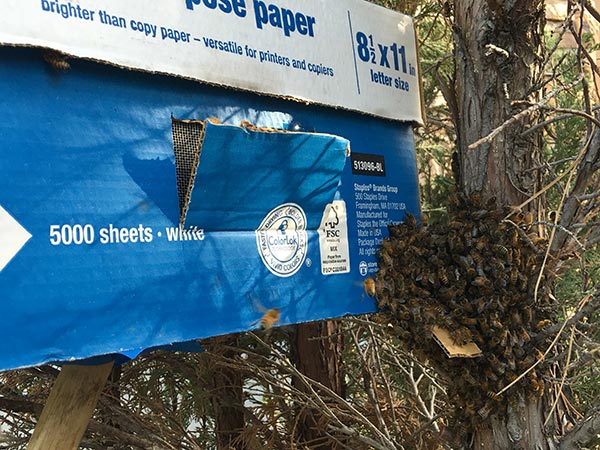
The buzzing was filling my chest and I was truly euphoric, strolling around on the sidewalk, waiting for the bees to rejoin their queen. I assured the bees that getting into the box would be the best thing that ever happened to them, and that they would love their new hive, where they would be free to reproduce, pollinate and make honey to their heart’s content. I told them the honey I took in return would really be a small price to pay, and that they would be making a lot of people happy with it. They seemed too busy trying to get into the box to listen to me, or else they were just willfully ignoring me. But, I reminded myself, being ignored by a swarm of bees was really a good thing.
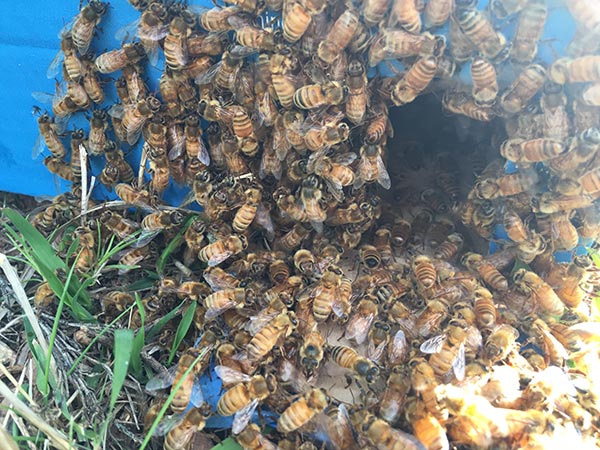
About an hour after I got the queen in the box most of the bees were inside, or on the flaps of the box. I put my leather gloves on and gently pushed the ones on the flaps into the box, which they didn’t mind at all. They almost seemed grateful for the help. Then I waited for the last stragglers to land on the box and make their way inside. There were 50 or so flying around...then 30...then 20...then only ten or so bees, out of thousands and thousands, remained flying around the box. I wanted to stay until they all got in, but I knew that the chances were there would always be a few that kept flying. I waited a few more minutes, and then, after pushing more bees off the flaps and into the box, gently closed the box. I counted maybe eight bees left out of the box. I sealed the flaps of the box tightly with duct tape, gently set the box in the back of the car, strapped the ladder back on the roof, and drove away, feeling like I had just done something that should be illegal, or at least tightly regulated, like codeine or bungee jumping. It was like visiting an oracle and being told something in a secret language of vibration. A few people had stopped to ask me questions as I was working, and all of them were in awe and very appreciative of what I was doing. The whole experience was far beyond what I had expected, a journey of centuries in one trip across town.
The last part, putting the bees in the hive, turned out to be far and away the simplest. I let the bees spend the night in the box, as I didn’t want any stragglers to be caught out at night (another suggestion from my bee-keeping friend).
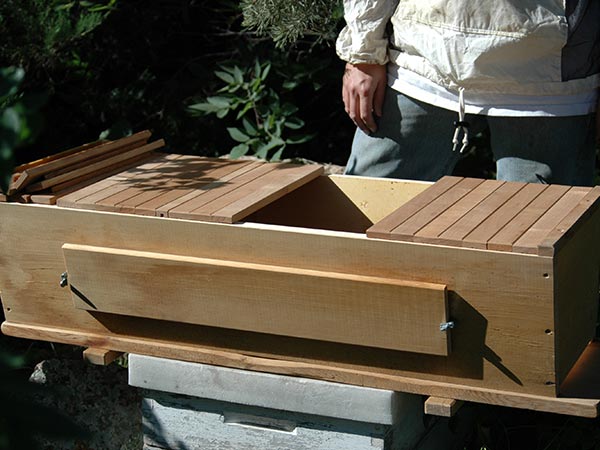
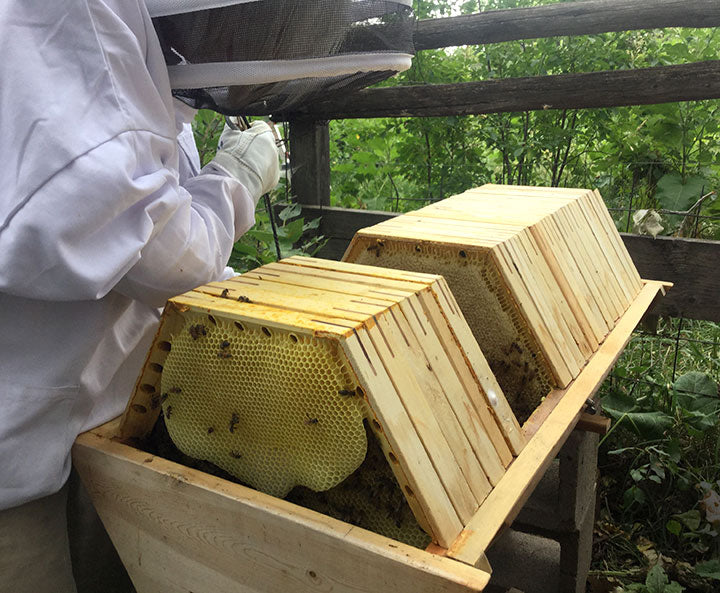
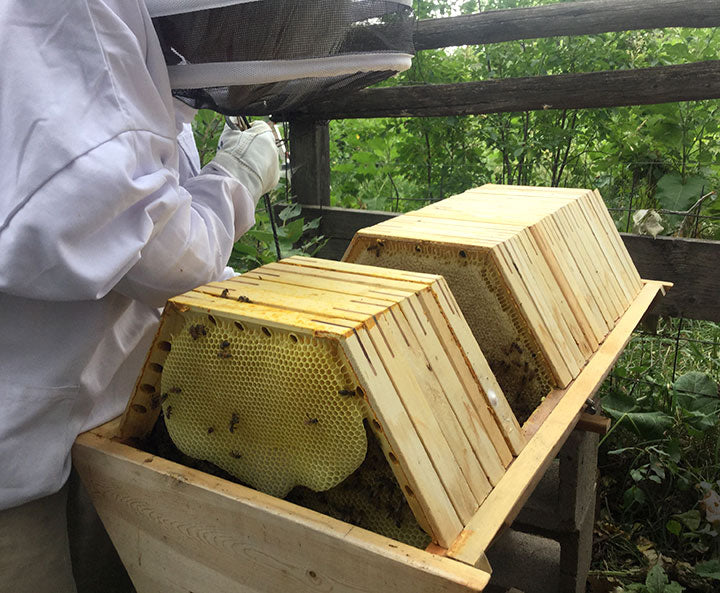
In the morning I took a few bars out of my hive and unsealed the bee box. By peeking inside gently and carefully I ascertained where the swarm was: in one of the top corners of the box. I slowly opened the flaps, then tilted the box, the corner with the swarm in it down, over the hive. I was about to shake the box when the bees just slid into the hive. This time any that were left out immediately flew into the hive, like they knew mom had found them the home of their dreams. I replaced the bars and put the top on the hive, and the bees went to work, almost immediately. Now we have a happy, thriving hive, a lot of locally pollinated flowers, and our first few jars of nature’s golden nectar. Nice quiet bee-friendly state.
More information on catching bee swarms and obtaining bees for your hive. How to Get Bees for your Hive
Our Full Length Training Video includes a full chapter on catching a wild swarm and putting the swarm of bees into your hive. Check it out here:
BackYardHive Streamable Beekeeping Training Video